 |
 |
 |
|
|
|
||||||
|
 |
 |
|
||||||||
|
 |
Development and Coaching: What Does that Mean? | |
||||||||
|
|
|
|||||||||
|
What is Development?
We mostly try to do that by learning new skills, adding to our competencies. However, from time to time, we seem to hit a brick wall, a problem we don’t seem to be able to solve, or a situation we don’t know how to handle. We can find the information that is supposed to help us solve the problem, but it somehow isn’t enough. The situation seems to demand a quality of “being.” We need to be the leader, manager, spouse, parent that intrinsically knows how to be and what to do in that situation, from a real and authentic place. It is not possible to fake it, nor does it seem to be purely a matter of knowledge or skills.
If we look at the situation with as much honesty and clarity as we can muster, we will see that the “brick wall” is permeable. It is composed of the way in which we think and feel, how we make sense and meaning of the world, our belief structures about how things are and what’s possible. The brick wall may look like its external, out there, but a closer examination reveals it’s not.
That is the good news. If it’s internal, it can be removed – simple in concept, not so easy in practice. To remove the self-imposed limitation, it is necessary first to see the content of the wall – what values, beliefs or constrictions form these bricks? The second question is what’s the mortar and cement that holds them in place, and who put them there?
The answers are that the mortar and cement are the ways in which we think and feel about the world and ourselves, how we make sense and meaning. The who is us – more specifically, the stage of development we find ourselves in. To quote Einstein, “we cannot solve a problem at the same level of thinking we created it.”
What Do We Know about It? Over the last half-century, research in psychology and sociology has determined that human beings develop through distinct stages. That children develop through such stages is fairly well known. However, adults also continue to develop along multiple dimensions, including cognitive (Piaget, Basseches), social-emotional (Kegan, Goleman), moral (Kohlberg), self (Loevinger, Cook-Greuter, Torbert), values (Graves, Beck), needs (Maslow), and others. Each higher developmental stage enables more of the individual’s inherent potential to be realized.
Cognitive Development Cognitive development determines how we make sense of the world, how much we are aware of, how fluidly, systemically, and comprehensively we think, and how much complexity we can manage. We progress from reactive to logical to dialectic thinking, which sees the world as dynamic and constantly changing, rather than static. Dialectic thinking develops our ability to create flexible and creative solutions and responses to problem situations, and to effectively adjust our responses as situations evolve. Michael Basseches' article The Development of Dialectical Thinking As An Approach to Integration in the on-line journal Integral Leadership Review discusses dialectic thinking in depth. The impact of dialectic thinking on leadership is explored in the Integral Leadership Review article Business Leadership for an Evolving Planet: The Need for Transformational Thinking in Intercultural and International Environments I co-wrote with Dr. Otto Laske and the IDMA team at the Interdevelopment Institute.
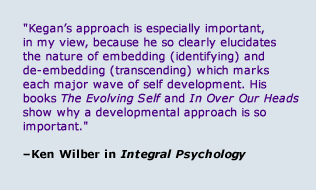
Social-Emotional Development Our social-emotional development defines how we make meaning of events and respond emotionally to situations in our lives. Our response is based on our perceptions about ourselves, other people and the world. We work here with the model developed by Robert Kegan in The Evolving Self, as extended by Otto Laske in Measuring Hidden Dimensions: The Art and Science of Fully Engaging Adults. Kegan’s research discovered five stages of human social-emotional development. The adult stages of interest to us are: Stage 2 Instrumental: egocentric and self-focused, uses other to gratify needs Stage 3 Other Directed: influenced by internalized others, seeking approval Stage 4 Self Authoring: clear about one's own values and sense of self, accepting of others' differences Stage 5 Self Aware: objectively aware about one's own meaning making, open to selective influence as part of growth process
Values Development A third model of interest to us is called Spiral Dynamics, and this describes how our value systems evolve, how what is important to us changes as we grow. The original research conducted by Clare Graves was refined and extended by his collaborator Don Beck. This model has been widely used and discussed. A full description is available in Spiral Dynamics by Don Beck and Christopher Cowan. For an excellent article by Don Beck and Jessica Roemischer, explaining the model, click here. Much more is available on the web, particularly in the Spiral Dynamics section on the What is Enlightenment? magazine website. Spiritual Intelligence Development The life conditions and problems we face as a species, as countries, as organizations and as individuals demand increasing complex/elegant solutions. The type of mature leader who can respond to such situations is a “Tier 2” leader—embodying an advanced stage of personal development. These high levels of adult development are inseparably linked to spiritual intelligence. Thus, mature leadership requires spiritual intelligence development. The result is a leader who leads from the inside out: who she is, is how she leads Cindy Wigglesworth defines Spiritual Intelligence as “The ability to behave with Wisdom and
Compassion while maintaining inner and outer peace (equanimity) regardless of
the circumstances.” Cindy developed the SQ21 Spiritual Intelligence Assessment with three goals
in mind: For more on leadership and spiritual intelligence please read Spiritual Intelligence and Mature Leadership by Cindy Wigglesworth.
Developmental Coaching So, how do you change or raise your level of development? Up to a point, the process of development is natural, if unconscious. This “point” is the level of development of a society and culture. This level acts as an attractor pulling people to the dominant belief and value structures. Beyond that, the “pull” is an inhibitor, restraining people from developing past the prevailing ways of making sense and meaning of their lives and work. Developmental coaching makes the development process conscious and assists you in growing to your full and true potential.
The ITS developmental coaching process begins with an assessment along three dimensions: cognitive, social-emotional and behavioral. Cognitive and social-emotional assessments are based on hour long semi-structured interviews. The behavioral instrument is based on a psychological instrument.
The cognitive assessment measures the client’s ability to think dialectically and systemically. The social emotional assessment determines the client’s location on the Kegan developmental scale, their potential to develop to the next stage, and risk of regression to an earlier stage. The behavioral assessment determines areas of strength and weakness for the client across 18 variables in three groups: self-concept, task focus, and interpersonal perspective, relative to managerial norms and the client’s specific work or life environment. Otto Laske's article Mentoring a Behavioral Coach in Thinking Developmentally: A Dialogue explains the process in depth.
These assessments provide the client with considerable insight into the underlying causes of their barriers to success. The coaching process focuses on the specific problem areas identified by the behavioral assessment, and agreed to by the client. The core mechanism of development is that of witnessing one’s own mind and heart, converting subject into object. The coach assists the client to make visible the hidden structures of their current developmental level, the ways of thinking, feeling, and acting that cause their specific problems. He then helps them see how the expanded ways of thinking and feeling available in the emerging stage can resolve their issues. The new stage is, in a fundamental way, foreign to the client's sense of self. In the normal course, it takes a significant amount of time for people to become comfortable with an expanded perspective and self-identity. By deliberately modeling the emerging stage, the coach enables the client to trust their new way of being, and significantly expedites the process.
We are living in a world that appears to constantly move faster and become more complicated, constantly defying our ability to meet its challenges. We need some assistance to grow rapidly enough to meet these challenges as they come at us. Developmental coaching provides that assistance.
External Links to References on this Page The Development of Dialectical Thinking As An Approach to Integration by Michael Basseches Business Leadership for an Evolving Planet: The Need for Transformational Thinking in Intercultural and International Environments by The IDMA Team at the Interdevelopmental Institute: Sunil Ahuja, Scottsdale, AZ, USA; Jon Ebersole, Affoltern am Albis, Switzerland; Otto Laske, Medford, MA, USA; Pia Neiwert, Berlin, Germany; Mirna Perez, Mexico City, Mexico; Ron Stewart, Portland, OR, USA. Mentoring a Behavioral Coach in Thinking Developmentally: A Dialogue by Otto Laske, Director, Interdevelopmental Institute The Never-Ending Upward Quest (article on Spiral Dynamics) by Jessica Roemischer Spiral Dynamics on What is Enlightenment? website. Spiritual Intelligence and Mature Leadership by Cindy Wigglesworth
For more information on our Development Coaching programs, please click on the links below:
|
|
|||||||||
|
|
|
|
||||||||
|
|
|
Copyright ©2006 Sunil Ahuja. All rights reserved. | |
|||||||
|
|
|
Home | About Us | Workshops | Spirit in Life | Spirit at Work | Newsletter | Register | Online Store | Calendar | Resources | Contact For questions about this site, please contact us. |
|
|||||||
|
|
|
|
||||||||






 We all want to be more – more successful, more competent, more capable, more effective professionally and personally, happier, wealthier, or better leaders, managers, spouses, parents, or friends.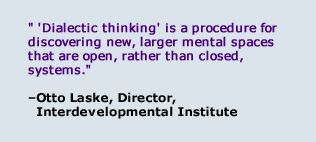
 As we develop through these levels, our emotional capability increases. We become more aware of our own response patterns, see ourselves and others more objectively, manage our reactions more easily and effectively, and relate more empathically to others.